

Apparently, I Don’t Have An Off Button: Why Rest Doesn’t Feel Restful
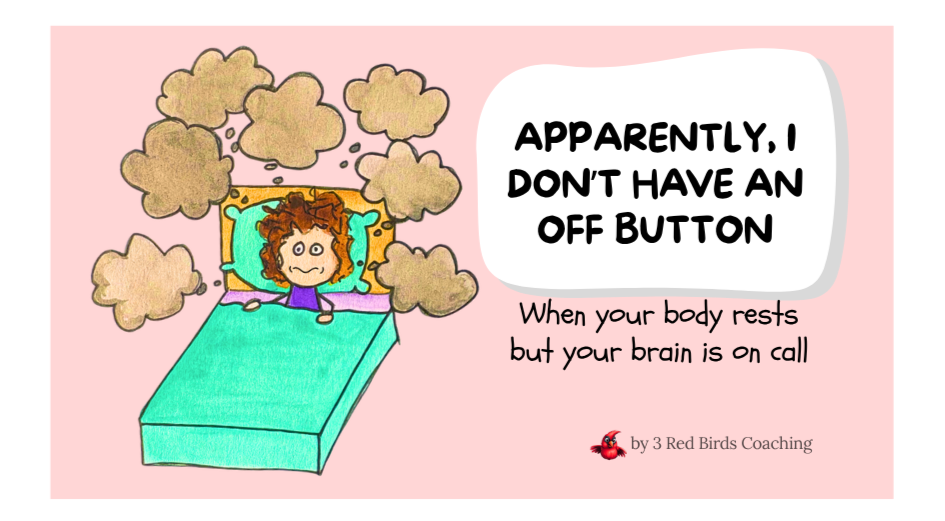
The invisible responsibilities, internal rules, and mental load that keep you working — even after you sit down.
Think about what happens when you put a computer into sleep mode. The screen goes dark, and from the outside, it looks as though everything has shut down. Yet sometimes, you can still hear a faint whirring inside.
That is us.
We tell ourselves, You’ve worked hard enough. It’s time to rest. We sink into our favorite chair, our body finally still—and then there it is. The mind keeps running in overdrive.
No one may be asking anything from you at that exact moment. The dishes can wait. Your phone is quiet. Maybe everyone else has gone to bed, left the house, or become occupied with something that does not involve you. Your body has finally stopped moving, but your mind has not.
Did I respond to that message? What time is the appointment tomorrow? We’re almost out of milk. I need to check on Mom. Did I sign that form? I should probably switch the laundry. I wonder if she’s upset with me. I need to remember to—
And there it is.
You are sitting down, but you are not resting. Your body may be in the chair, yet your mind is still walking through every room, checking every person, reviewing every conversation, and preparing for every possible problem. You may even begin to feel more anxious sitting still than you felt while you were busy, so you get back up—not necessarily because something urgently needs to be done, but because doing something feels easier than sitting with the discomfort of doing nothing.
Stopping Is Not the Same as Going Off Duty
We often think of rest as something physical. Sit down. Take a bath. Watch television. Go to bed early. Take a day off. But physical stillness does not automatically create mental rest.
You can be lying in bed while mentally organizing tomorrow. You can be watching a movie while listening for someone to need you. You can take a day off and spend the entire day feeling guilty about what you are not accomplishing. This is why someone can technically have time to rest and still feel completely depleted.
It may sound ironic to say that rest takes action, but for many of us, it does. We have to intentionally remind our brains that not everything is urgent, that the trash can wait, and that sitting down does not mean we are neglecting something important. Real rest requires more than stopping the body. It requires the mind to loosen its grip on responsibility, urgency, and vigilance—even briefly.
Researchers sometimes call this psychological detachment: the ability to mentally disconnect from the demands that have been consuming our attention. Studies on recovery consistently find that being able to detach, relax, and experience some control over personal time is connected to better recovery, well-being, and sleep.
That sounds simple—until you have spent years believing that staying mentally on duty is part of being a good mother, daughter, partner, employee, caregiver, or friend.
The Work No One Can See
Some responsibilities are easy to recognize. Preparing meals is work. Driving someone to an appointment is work. Cleaning the house is work. Helping with homework is work.
But there is another kind of work that is much harder to see. It is remembering what needs to happen, anticipating what might go wrong, and noticing when someone’s mood changes. It is keeping track of schedules, medications, groceries, forms, birthdays, needs, and unfinished conversations. It is thinking three steps ahead so no one else has to, monitoring the emotional temperature of the room, and wondering whether everyone is okay—and what you should do if they are not.
This is sometimes described as cognitive labor or mental labor. Research continues to find that women frequently carry a disproportionate share of the remembering, anticipating, organizing, and emotional management involved in family life. This type of invisible labor has been associated with greater stress, burnout, emotional exhaustion, role overload, and poorer well-being.
The exhaustion is real, even when no one else can see what you have been doing. You are not “just sitting there thinking.” Your mind has been working an unpaid, unrecognized shift, and unlike a job with defined hours, this one rarely tells you when your shift is over.
Why Rest Can Feel So Uncomfortable
Sometimes we assume that people who struggle to rest simply need to practice better self-care. Take more time for yourself. Schedule a massage. Read a book. Put your feet up. Just do it. Right?
As though it is really that easy for us people-pleasing overachievers.
Those things may feel wonderful, but they do not address the beliefs that make rest feel unsafe, selfish, irresponsible, or undeserved. You may sit down and immediately hear, I should be doing something. Other people don’t get to rest. There is too much left to do. Someone might need me. I haven’t earned this yet. I’m being lazy. I’ll relax after everything is handled.
The problem is that everything is never completely handled. There will always be another task, another need, another person, another concern, or another possibility for something to go wrong. Even when nothing especially heavy is pressing on us, one dust bunny floats across the living room, and suddenly we’re in the middle of a full-on housecleaning spree, convinced we “had” to do it.
When rest depends on completing everything first, rest will remain just out of reach.
The Internal Rules Behind the Exhaustion
Many women are not following a written list of expectations. They are living according to internal rules they absorbed over time: a good mother remembers everything; a strong woman handles things without complaining; a dependable person is always available; a caring daughter puts her parents first; a loving partner notices what everyone else needs; a productive person does not waste time; and a good woman does not inconvenience other people.
These rules may have helped you feel accepted, needed, capable, or safe. They may have become so familiar that they no longer sound like beliefs. They sound like facts.
The problem is that every internal rule comes with a cost. If being good means always being available, you can never fully turn off. If being strong means doing everything yourself, support may feel more threatening than exhaustion. If your worth comes from being useful, rest can feel like losing the very thing that makes you valuable.
That is why this is not simply a time-management problem. It is a relationship-with-yourself problem.
When We Keep Ourselves on Duty
I want to say this as gently as possible, because I know how easy it is to feel defensive or misunderstood when we are already carrying so much.
Sometimes, without realizing it, we become part of what keeps us exhausted. We develop a quiet belief that we are indispensable. If I don’t do it, no one else will. If someone else does it, they won’t do it correctly. It will take too long to explain. It will be easier if I just handle it myself.
Sometimes that may even be true. Someone else may not do it exactly the way we would. They may load the dishwasher differently, forget a detail, or need to learn through trial and error.
But different does not automatically mean wrong.
I can only speak from my own experience, and this is not always comfortable to admit: there were times when I willingly put on the martyr hat. I stepped in before anyone else had the opportunity. I took control because I trusted my way more than theirs. I insisted on doing everything—and then turned around and complained about how much I “had” to do.
The truth was that I did not always have to do all of it.
Sometimes I was afraid to let go. Sometimes being the dependable one made me feel important, needed, or secure. Sometimes it felt easier to carry resentment than to risk asking for help, accepting a different outcome, or allowing someone else to struggle through learning how to do it.
Acknowledging that does not erase the very real responsibilities I carried. It simply helps me recognize where responsibility ended and my need for control began. That awareness is not about blaming ourselves for being exhausted. It is about noticing where we may have more choice than we realized.
For me, bedtime is often when I can almost taste the freedom. I picture myself nestled into my awesome bed, finally drifting off into bliss.
Nope.
My head hits the pillow, and I begin cycling through everything I didn’t finish, everything I forgot, or everything I need to do tomorrow. Before my feet even hit the floor, I’m already off to the races—still trying to prove how strong, capable, reliable, dependable, and hardworking I am.
Even in bed, my body may be off duty while my mind continues working the night shift.
Rest Is Not Something You Earn
Rest is often treated like a reward. Finish everything, and then you can rest. Take care of everyone, and then you can rest. Prove you have worked hard enough, and then you can rest.
But rest is not the prize you receive for reaching the end of your responsibilities. It is one of the things that allows you to continue living your life with thoughtfulness, patience, health, and intention.
Caregiver research has repeatedly connected caregiving demands and worry with disrupted sleep and poorer recovery. Rumination—the mind continuing to replay and manage concerns—can keep the effects of stress active long after the immediate task is over.
Rest is not proof that you have stopped caring. Rest is not abandonment. It is not laziness. It does not mean that everything is finished or that no one will need anything tomorrow. It means that, for this moment, you are allowing yourself to exist without immediately turning your existence into another task.
Five Ways to Begin Taking Your Mind Off Duty
Name the invisible work. At the end of the day, do not only list what you physically accomplished. Also acknowledge what you remembered, anticipated, managed, monitored, and emotionally carried. Naming invisible labor helps you understand why you are tired. You are not exhausted “for no reason.”
Create a closing ritual. Your mind may continue working because it is afraid something important will be forgotten. Before resting, write down unfinished tasks, concerns, and reminders. Tell yourself, I do not have to solve this now. I have recorded it, and I can return to it tomorrow. You are not pretending the responsibilities do not exist. You are giving your brain permission to stop rehearsing them.
Notice the rule beneath the guilt.When guilt appears, pause before obeying it. Ask yourself: What am I telling myself I should be doing? What do I believe it means about me if I rest? Whose expectation am I trying to meet right now? The goal is not to argue with yourself. It is to become aware of the rule driving the discomfort.
Practice small moments of being unavailable. If an hour of rest feels impossible, begin with five or ten minutes. Put the phone down. Leave a nonurgent task unfinished. Allow someone else to solve a minor problem. Sit without using the time to plan, organize, or improve anything. Rest is a capacity, and you may need to build your tolerance for it slowly.
Share ownership—not just individual tasks. Sometimes asking someone to “help” still leaves you responsible for noticing what needs to be done, assigning it, explaining it, checking it, and reminding them. That is not fully sharing the load. Sharing ownership means another person also participates in remembering, planning, and following through. You deserve support that reduces the mental responsibility—not support that turns you into the manager of one more person.
Expect Rest to Feel Unfamiliar
The first goal is not to make rest immediately feel wonderful. The first goal may simply be to remain seated when the old voice tells you to get up, to notice the guilt without treating it like an instruction, to let someone wait a few minutes, and to leave something unfinished.
You are learning that discomfort does not always mean you are doing something wrong. Sometimes discomfort means you are doing something differently.
Different can feel hard—and hard does not mean wrong. Sometimes it means growth is happening. You are interrupting a pattern that once convinced you that your value came from how much you could carry.
A Final Reflection
The next time you finally get a chance to rest, notice what happens inside you. What thought tries to pull you back up? What responsibility follows you into the chair? What do you fear might happen if you were truly unavailable for a little while?
And perhaps the most important question: Who are you when you are not actively doing something for someone else?
You do not have to wait until every need is met, every task is completed, and every person is satisfied before you are allowed to rest.
The list may not be finished. The house may not be perfect. Someone may still want something.
You are still allowed to step off duty.
Not forever.
Just long enough to remember that you are a person—not only the person who keeps everything going.