

Every Day I’m Hustlin’ - Why Doing Everything Right Can Still Leave You Running on Empty
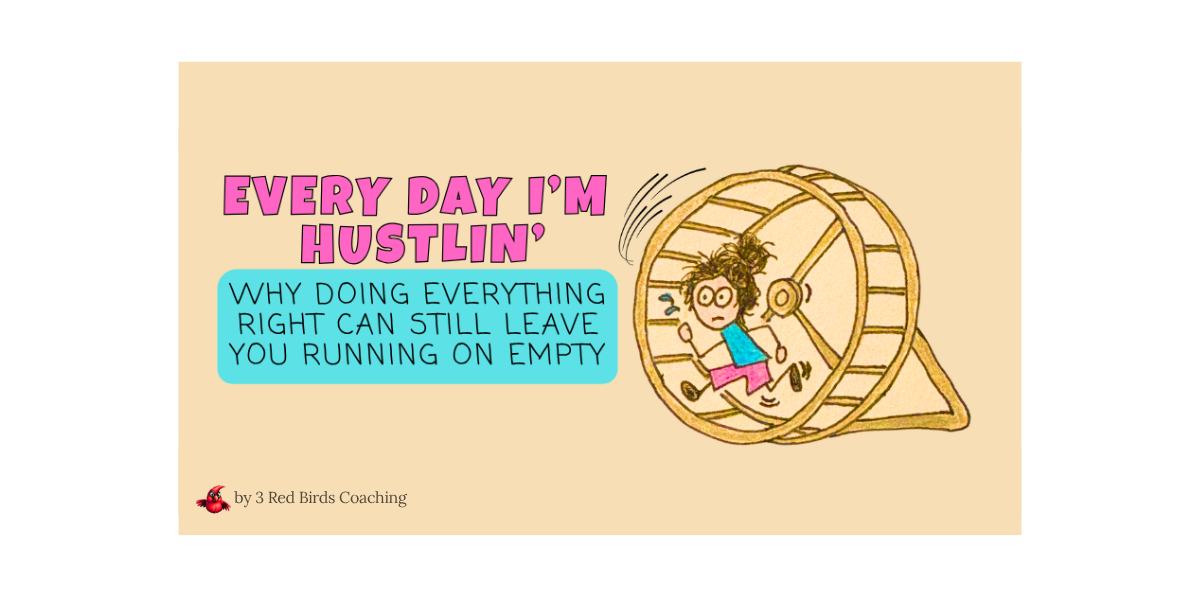
Why the invisible thoughts, rules, and patterns you carry can be just as exhausting as everything you do.
Some days can feel as though you are running inside a wheel.
You keep moving … doing, helping, fixing, remembering, anticipating, managing, and holding everything together. Yet no matter how much you accomplish, the wheel never seems to stop.
You finally sit down. Maybe it’s the first time you’ve stopped moving all day. You haven’t even had a chance to take a full breath when your phone buzzes, someone calls your name, or you remember the three things you forgot to do.
You get back up. Not necessarily because it’s an emergency. Not even because you are the only person capable of handling it.
You get up because somewhere inside you, a familiar voice has already spoken:
I should take care of it.
They’re counting on me.
It will be easier if I just do it myself.
I don’t want anyone to be disappointed.
I can rest when everything is done.
Except everything is never done and the wheel keeps turning.
Of Course You’re Tired
Let’s begin by acknowledging what you’re carrying may genuinely be a lot. Caregiving is not easy. Parenting is not easy. Working while caring for aging parents is not easy. Managing appointments, medications, household needs, finances, relationship concerns, unexpected crises, and everyone’s emotions can be physically and mentally draining.
You are not imagining the weight of it.
According to the 2025 Caregiving in the U.S. report from AARP and the National Alliance for Caregiving, approximately 63 million Americans—nearly one in every four adults—are providing ongoing care for someone with a medical condition or disability. More than 40 percent are providing what researchers classify as high-intensity care, and one in five caregivers reports being in poor health themselves. (AARP)
That is a lot of people carrying a lot of responsibility. What if the responsibilities themselves are only one part of the exhaustion? What if there is also an invisible layer of pressure being created by what you believe those responsibilities require of you?
For Years, I Thought Everyone Else Was the Reason I Was Exhausted
For 19 years, I was a caregiver. I was a single mother, worked full-time and part-time, and cared for family members through cancer, Parkinson’s disease, addiction, declining health, and loss.
I believed I was exhausted because everyone needed me.
To be fair, people really did need me. My circumstances were difficult. My responsibilities were real, but eventually I had to face something I hadn’t understood before.
My exhaustion wasn’t coming only from everything I had to do. It was also coming from the way I believed I had to do it.
I believed I had to be available.
I believed I should be able to handle everything.
I believed asking for help meant I wasn’t strong enough.
I believed someone else’s disappointment meant I had done something wrong.
I believed everyone else’s needs were more urgent and more important than mine.
The caregiving was difficult. But those beliefs added another job on top of the caregiving: the job of constantly proving that I was good, dependable, strong, capable, and worthy.
That was the part I couldn’t see.
The Situation Matters—But So Does the Story Your Mind Tells About It
Psychologists sometimes use the word appraisal to describe the meaning we assign to a situation. That sounds technical, but it is actually something we all do every day.
Something happens, and almost instantly, our mind decides what it means.
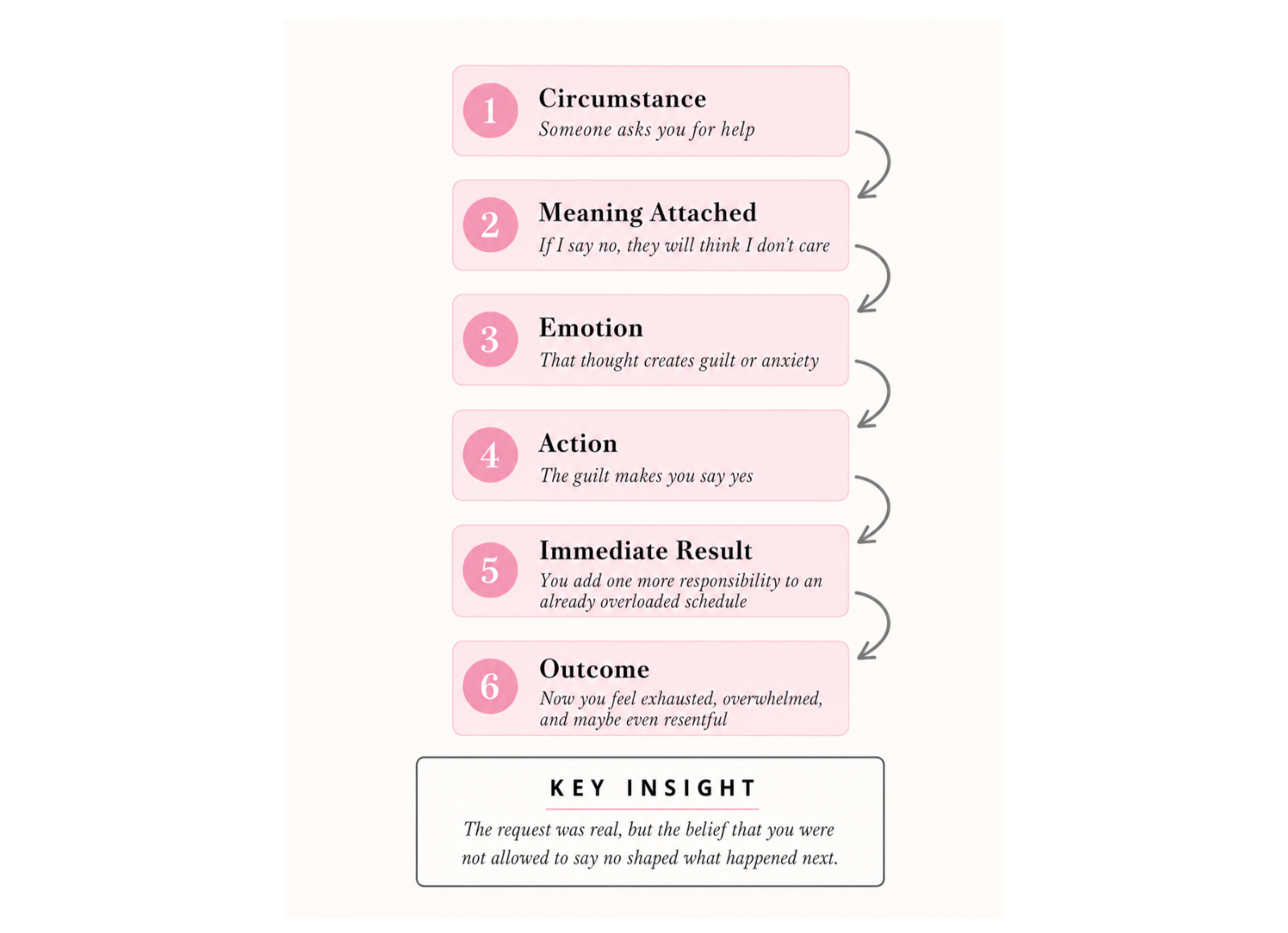
Someone asks you for help. That is the circumstance.
Your mind says: If I say no, they will think I don’t care. That is the meaning you have attached to it.
The thought creates guilt or anxiety. The guilt makes you say yes, adding one more responsibility to an already overloaded schedule.
Then you feel exhausted, overwhelmed, and perhaps even resentful.
The request was real, but the belief that you were not allowed to say no shaped what happened next.
Research on the practice of looking at a situation from another accurate perspective has found that changing how we interpret an event can reduce the amount of emotional distress we experience, even when the event itself has not changed. This does not mean pretending something is easy or forcing yourself to “think positively.” It means recognizing that the first story your mind produces is not always the only possible story. (PMC)
This Is Not About Blaming You for Your Stress
I want to be very clear about something. In no way am I suggesting your thoughts caused someone’s illness. Your mindset did not create your family’s needs. You cannot positively think your way out of grief, financial strain, medical uncertainty, an unfair workload, or a lack of support. Sometimes circumstances are simply painful, exhausting, and unfair.
Understanding the role of your thoughts is not about blaming yourself for having a difficult time. It is about discovering where you may have more influence than you realized.
You may not be able to control what someone needs from you, but you can begin questioning the belief that you must meet every need immediately.
You may not be able to control someone’s disappointment, but you can begin questioning the belief that their disappointment means you made the wrong decision.
You may not be able to remove every responsibility, but you can begin questioning why you believe you must carry all of them alone.
That is not blame. That is awareness, and awareness gives you choices.
The Hidden Rules That Keep You Running
Many of us are living by rules we never consciously chose. We learned them through our families, relationships, culture, experiences, and the responses we received from others.
Some of those rules may sound like:
A good mother always puts her children first
A loving daughter should always be available
Strong people don’t need help
Rest has to be earned
Saying no is selfish
If someone is upset with me, I need to fix it
If I can do something, I should do it
My needs can wait
It is easier to keep the peace than to speak honestly
I should be able to handle this better
If I stop holding everything together, everything will fall apart
When you have followed these rules for years, they stop sounding like thoughts. They begin sounding like facts.
You no longer think, I have a belief that I should always be available. You think, I have to be available. That small difference matters.
A belief can be examined. A fact appears to leave you no choice.
Why Your Mind Keeps Repeating the Same Messages
Your mind is designed to notice patterns and repeat what has felt familiar, effective, or protective in the past.
Maybe saying yes helped you avoid conflict.
Maybe being helpful earned praise or approval.
Maybe anticipating everyone’s needs made an unpredictable home feel a little safer.
Maybe staying busy kept you from noticing your own fear, sadness, anger, or loneliness.
The pattern may have served a purpose,but a pattern that once protected you can eventually exhaust you.
Even when you know you want to respond differently, your familiar reaction often shows up first. That doesn’t mean you are incapable of changing. It means your automatic response has had a lot more practice.
The goal is not to become a completely different person overnight. The goal is to create a small pause between what happens and what you automatically do next.
That pause is where change begins.
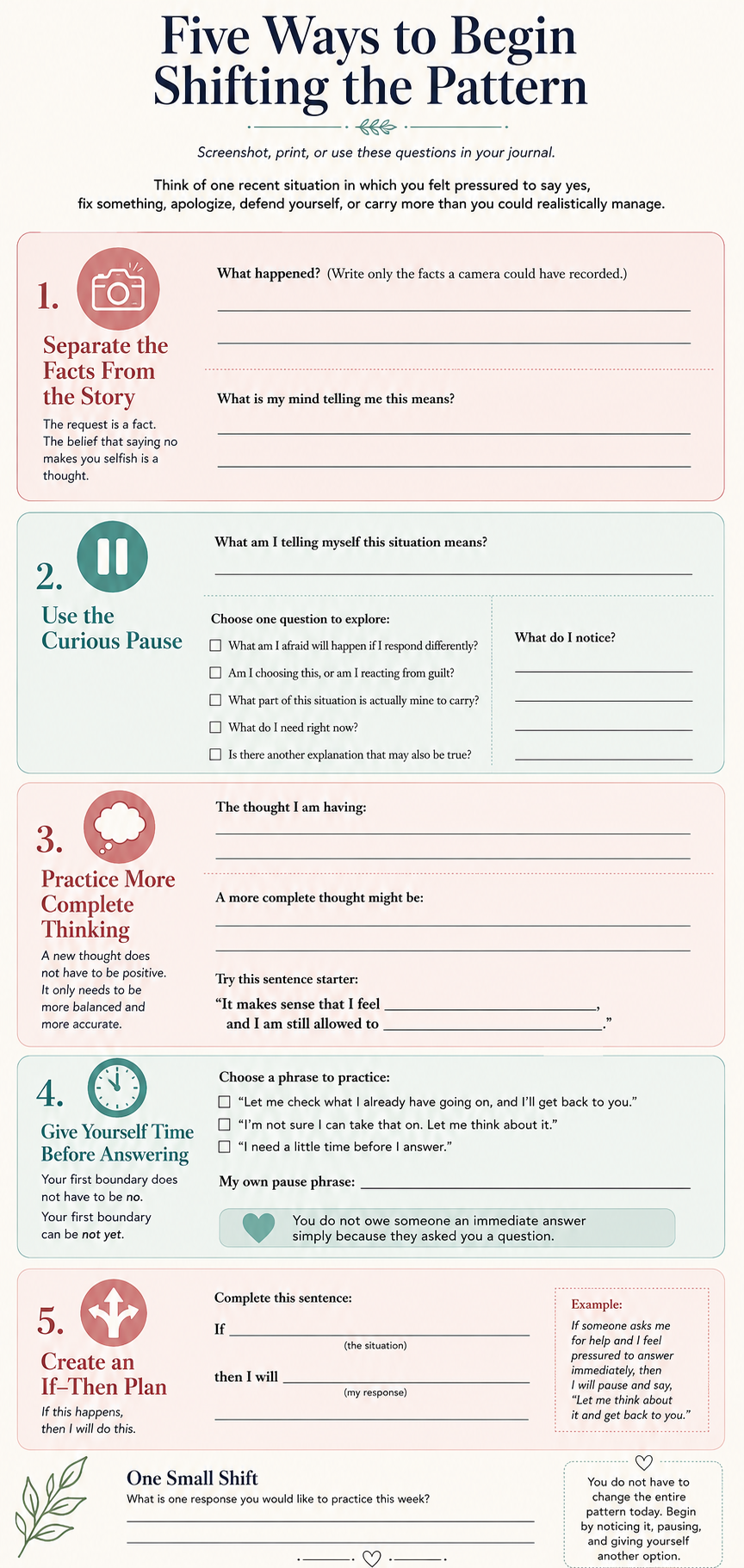
Research suggests that these specific “if-then” plans can help people turn an intention into an actual behavior because the response has already been decided before the stressful moment arrives. (PMC)
For example:
If someone asks me for help, then I will pause before answering
If I notice myself saying, “I should,” then I will ask whether I am choosing or obeying
If someone is disappointed by my boundary, then I will remind myself that disappointment is not an emergency
If I begin replaying a conversation, then I will write down the fact and the story separately
If I become critical of myself, then I will speak to myself as I would speak to someone I care about
If I feel resentment building, then I will ask what I agreed to that I did not truly have the capacity to give
Choose one plan. Small, repeated changes are more helpful than creating a long list that becomes another standard you feel pressured to meet.
What About the Thoughts That Won’t Stop?
Sometimes the exhausting part isn’t only what happened. It is how many times we continue reliving it.
We replay the conversation.
We plan what we should have said.
We imagine what the other person must think.
We criticize our response.
We predict what might happen next.
The body may be sitting on the couch, but the mind is still working overtime.
Researchers call this rumination—repeatedly circling the same upsetting thoughts without moving toward a solution. Studies involving caregivers have connected worry and rumination with greater anxiety, depressed mood, and emotional distress. (PMC)
When you notice this happening, try asking yourself, “Am I solving something right now, or am I repeatedly suffering through it?”
If there is a problem you can address, identify one specific next step.
If there is nothing you can act on right now, gently return your attention to what is happening in the present moment.
You might notice your feet on the floor.
Take one slower breath.
Name five things you can see.
Place a hand on your chest and say, “This is hard. I do not have to solve all of it in this moment.”
Research on mindfulness and self-supportive practices suggests they can help reduce stress by changing how people relate to difficult thoughts and feelings. The goal is not to prevent painful emotions. It is to experience them without adding another layer of judgment and self-attack. (PMC)
Expect the New Choice to Feel Uncomfortable
One of the biggest mistakes we make is assuming the right decision will immediately feel peaceful. That may be true … sometimes.
If you commit to working on this shift, prepare yourself for the fact that when changing a lifelong pattern, the healthier choice may initially feel really uncomfortable, even impossible.
Saying no may bring guilt.
Allowing someone to be disappointed may make you anxious.
Resting while something remains unfinished may feel irresponsible.
That discomfort does not necessarily mean you are making the wrong choice. It may mean you are making an unfamiliar one.
The old path feels natural because you have walked it thousands of times. The new path may initially feel awkward because you are still creating it.
You do not have to wait for the guilt to disappear before making a different choice. Sometimes the guilt becomes quieter only after you repeatedly show yourself that you can survive it.
You Are Not Tired Because You Are Weak
It amazes me how many people I work with describe themselves as weak or feel as though they are failing simply because they are exhausted.
Exhaustion is not proof of weakness.
You may also be tired because you have been carrying invisible expectations alongside them.
The expectation that you must always be strong.
The expectation that you must keep everyone happy.
The expectation that your needs should come last.
The expectation that you should be able to do everything without needing anything from anyone.
You may not be able to change every circumstance in your life, but you can begin noticing the thoughts, beliefs, and patterns that tell you there is only one way to respond to those circumstances.
You can pause before automatically saying yes.
You can allow someone to have an emotion without making it your responsibility to fix.
You can recognize that caring about someone and setting a limit can exist at the same time.
You can begin treating your own needs as important information instead of inconvenient interruptions.
You can make one small choice that includes you.
For years, I believed everyone else was the reason I was exhausted. What changed my life was discovering there was more to the story.
There may be more to yours, too. Becoming curious and understanding that story is not one more thing you have to get right, it’s simply a good starting point.
A Final Thought
You do not have to change your entire life today.
Begin by noticing one conversation happening inside you. Pay attention to the meaning your mind attaches to what happens and how that meaning shapes what you feel and do next.
Then pause long enough to ask whether another thought—or another response—may also be possible.
Change does not always begin with a dramatic decision. Sometimes it begins with one moment of awareness, one small pause, and one choice that includes you, too.